On the night of 30 July 2011, in a small cove called Cala Montjoi, the most influential restaurant of our lifetime served dinner for the last time. Two years ago, that building reopened — not as a restaurant, but as a museum. It's called elBulli1846: one number for the 1,846 creations Ferran Adrià's team catalogued over three decades, and, by a coincidence he loved, the year Escoffier was born.
A restaurant that becomes a museum. Sit with that for a second. Not because it was old — because it changed what a kitchen is.
What actually changed
For most of a century, great cooking meant perfecting a canon. Escoffier had written the grammar; excellence meant speaking it beautifully. The avant-garde kitchen asked a different question entirely — not "how is this dish made?" but "what is cooking?" Adrià's motto was two words: comprender para crear. Understand, in order to create. His team split the workshop from the service, poured a fifth of the restaurant's spending into pure research, and wrote down every idea like a laboratory: numbered, dated, catalogued.
What came out of that cove didn't stay there. The foam from a siphon on a breakfast buffet. The sphere that bursts on the tongue. Gels that hold at heat, crisps made from anything, sous-vide run with a thermometer's honesty instead of a prayer. If you've plated any of it — and if you cook professionally, you have — you've spoken a language that was invented, tested and named by a small crew on the Catalan coast while most of the world wasn't looking.
That technique itself is an ingredient. That texture is a language. That understanding a product deeply enough gives you the right to remake it.
Why this matters to us
Here's the private working chef version. Your guests have eaten everywhere. The difference between a good week and a legendary one is three plates they've never seen — and those plates, almost always, come out of this toolkit. Not as gimmicks. As grammar. A chef who understands why a foam holds or why a gel sets doesn't copy recipes; they answer whatever the galley throws at them.
And there is a reason that understanding rarely arrives from a screen: what a bench gives you is correction while your hands are still moving — the wrong angle caught before it sets, the question you didn't know to ask answered because someone saw you hesitate. Not faster. Different, and available nowhere else.
The man who kept the door open
Which brings me to the problem: most of that generation ended up behind velvet ropes. The famous kitchens take a handful of stagiaires a year from thousands. The knowledge exists — behind doors that don't open when you knock.
Martin Lippo went the other way.
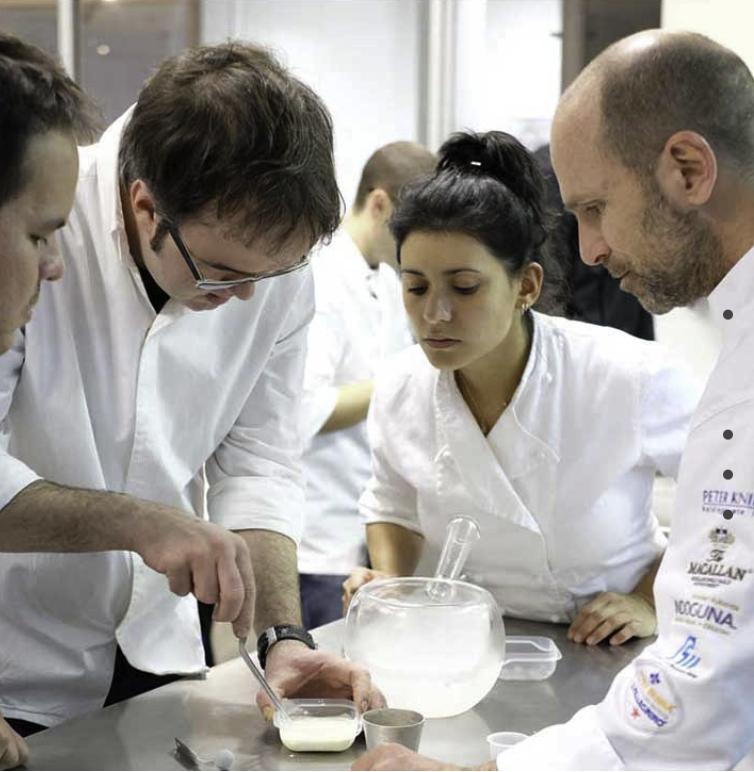
Argentine, named his country's most creative young chef at twenty-seven by its leading culinary magazine. In 1995 he co-founded Delfuego Traveling Chefs — cooking as a travelling conversation, years before anyone called that a concept. In Barcelona since 2000, right through the city's avant-garde supernova. And instead of a restaurant with a rope, he built Vakuum: a laboratory whose entire purpose is teaching. He founded the Nitro School there — liquid nitrogen is his signature terrain. Les Vergers Boiron, the French fruit house, built a sixty-video technique library around him; the pastry journal so good.. has featured his work across three issues. The people who write about him describe his cooking as standing between Adrià's modernism and Escoffier's classicism — one foot in the canon, one on the frontier. A bridge, in other words.
I've stood in that lab. Steel benches, glass spheres, the fog coming off the nitrogen — and a man who has spent twenty years choosing to put technique into other people's hands rather than guard it. In a trade full of gatekept brilliance, that's the rarest thing I know: not the talent — the open door.
The door, open
When I wrote this I was still only building something with Martin, in that lab, for chefs like us. It is now on the table: Lab Week 01 — five days at his bench in Barcelona, 22–26 October, built for working chefs off boats first. The honest numbers, the days, and the straight terms are all on one page.
Five days in Martin Lippo's lab
Confirmed at ten paid, capped at fifteen — or every euro comes back. Everything stated plainly, nothing sold that isn't real.
See the week →And the question I asked the Circle, which I'll ask you too — I read every answer:
The Circle hears it first
You tell me the skill you want to learn; I go and find where it is still alive, who still teaches it by hand, and who else is chasing it. One note when something is real — no funnel, no drip.
Join the Circle