Atlas / Kitchen & Cellar

Self-Sufficiency & Food Preservation

The one craft here sold as walking away from everyone — whose own founder said its whole point was to end up needing them.

Growing your own food, and keeping it through the winter, is real skill: soil, water, seed, and a preservation craft where a mistake can genuinely poison you. Almost everything else — the off-grid fantasy of total independence — is a picture the people who actually live it will gently take apart.

What it actually is

The least romantic version of a beautiful idea

Strip away the aesthetic and self-sufficiency is a year-round obligation: soil you feed before it feeds you, water you have to think about every day, seed you keep from one season to the next, animals that don't take holidays. It is mostly patience, done outdoors, in weather. The romance is real, but it arrives — if it arrives — only after the work.

And the second half of the craft, preserving what you grow, is not a hobby but a food-safety discipline. Put up low-acid food — most vegetables, meat — the wrong way and you can breed Clostridium botulinum, whose toxin can kill, and which can leave the jar looking and smelling perfectly fine. That is why low-acid foods need a pressure canner hot enough to destroy the spores; a pot of boiling water isn't. Knowing that line is the difference between a full larder and a dangerous one — the reason this is a skill you learn from people, not a video.

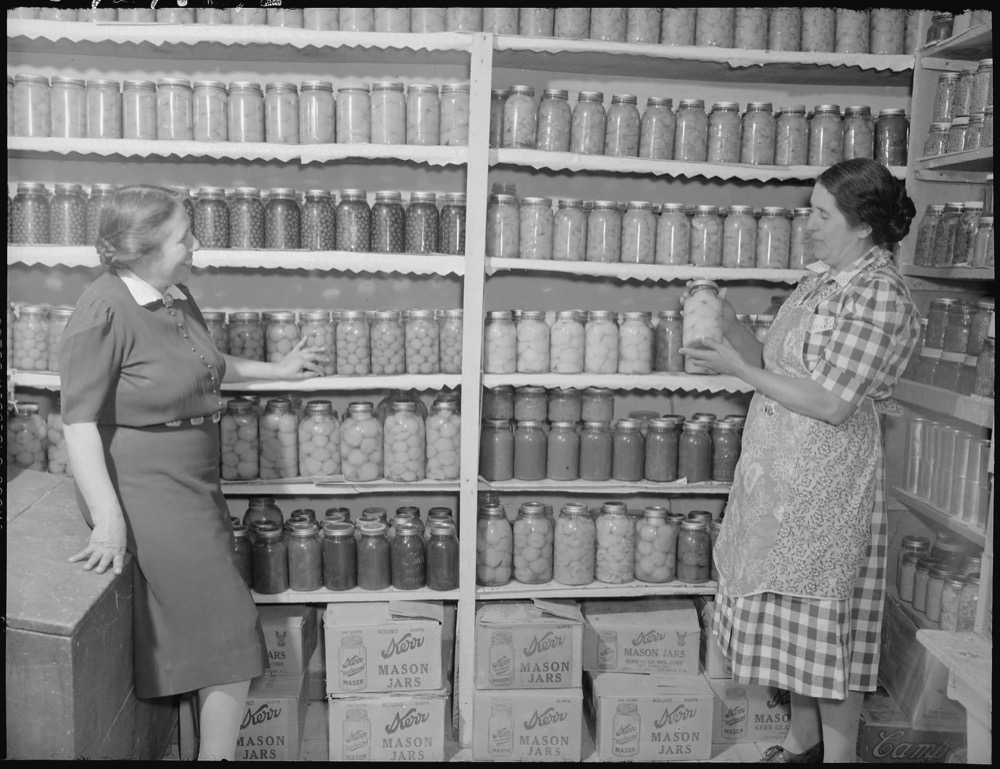
Two women in a 1946 New Mexico pantry stocked with home-canned fruit and vegetables
A New Mexico pantry, 1946 — a year's food, put up by hand.
Photo: U.S. National Archives · public domain
The part that surprises everyone

Four things nobody tells you about living off your own land

01

The word is 2,400 years old — and never meant doing it alone. "Self-sufficiency" is the Greek autarkeia, a prized virtue for Aristotle and the Stoics and part of eudaimonia, a flourishing life. But Aristotle's version pointedly included family, friends and fellow citizens; the Stoics meant an inner sufficiency, being whole in yourself. Neither ever imagined one person supplying everything alone.

02

Preserving food is the original biotechnology. Sauerkraut, kimchi, a barrel of pickles — they keep because Lactobacillus bacteria turn sugars into lactic acid and drop the pH below where rot can live. Humans ran that microbiology for thousands of years before anyone knew a microbe existed; it's routinely called our oldest biotechnology, and it's the ground the whole modern science grew out of.

03

We've quietly thrown away most of what we could eat. The FAO estimates about three-quarters of crop genetic diversity has been lost since 1900. Today just 12 plants and 5 animal species supply roughly three-quarters of the world's food — and of the 250,000 to 300,000 known edible plant species, we lean on only 150 to 200. Every jar of saved heirloom seed is a small vote against that.

04

Amateurs once grew nearly half of America's vegetables. In 1943, around 20 million home "victory gardens" produced about 42% of the produce grown in the United States that year. Not a fringe of enthusiasts — a country, feeding itself from its own back yards, on purpose.

Sources: Etymonline · Frontiers · FAO · National WWII Museum.

Where it comes from

The father of self-sufficiency taught people to need each other

If the modern idea has a founder, it's John Seymour (1914–2004), whose Complete Book of Self-Sufficiency (1976) sold the dream to a generation — the smallholding, the goat, the loaf and the cheese you made yourself. It's the book most people picture when they picture this life at all.

Here's the part that gets left out. You'd expect the man to preach independence — a fence, a gate, a family fed by no one but itself. He preached the opposite, and he did it in the founding book, not in some late-life change of heart. The whole point, he wrote, was to end up in a community.

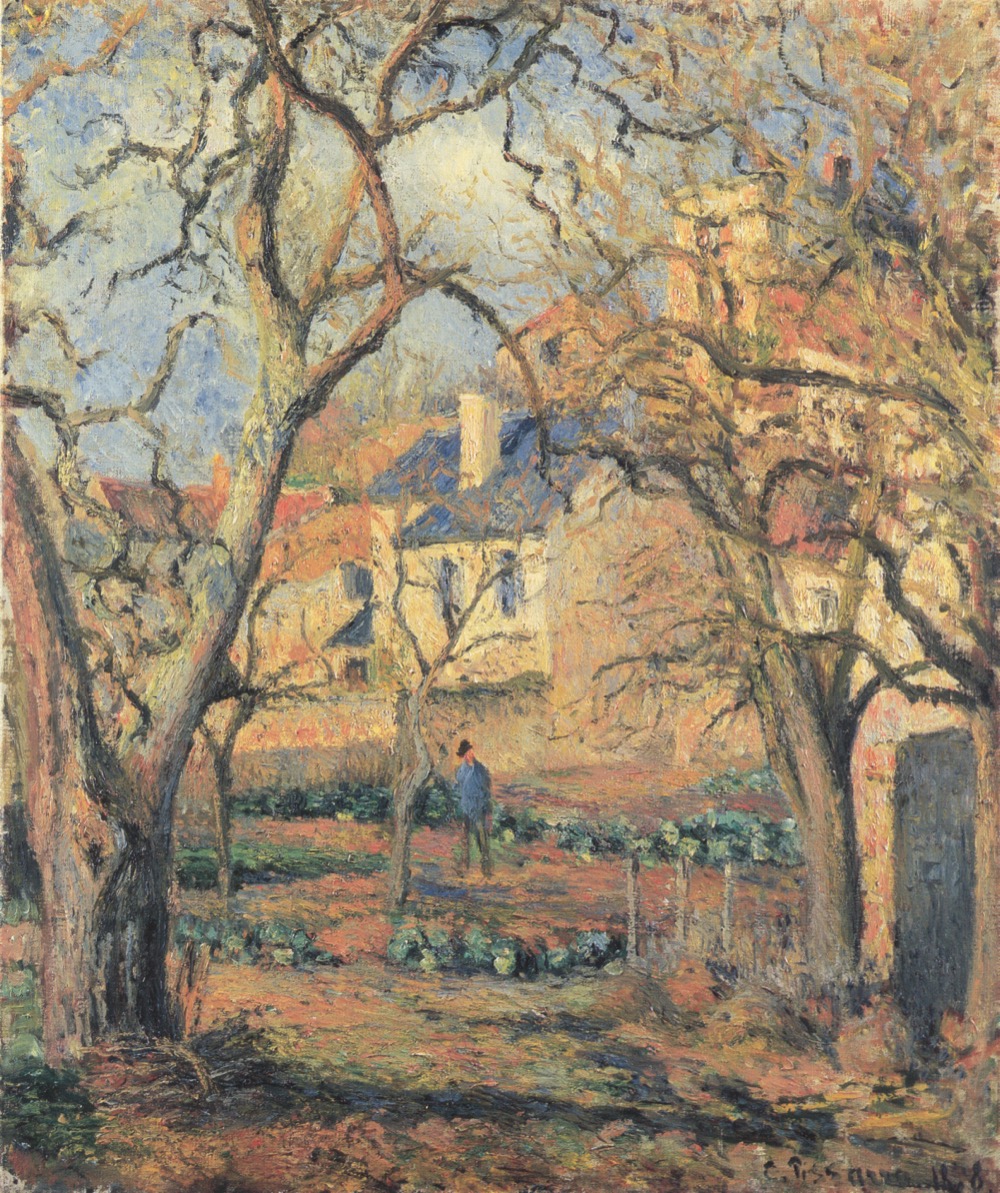
Camille Pissarro's 1878 painting of a kitchen garden at L'Hermitage
"Le Jardin potager à l'Hermitage," Camille Pissarro, 1878 — the kitchen garden, painted into a dream.
Public domain
A self-supporter, living alone surrounded by giant commercial farms, may be lonely too; but if he has other self-supporters near him he will be forced into cooperation with them and find himself, very quickly, part of a living and warm community. There will be shared work in the fields… barn-raisings and corn-shuckings and celebrations of all kinds. John Seymour · The Complete Book of Self-Sufficiency, 1976

That is the spine of everything below. The man who wrote the book on standing on your own two feet defined success as being forced into cooperation — as being worth having as a neighbour. The dream was never a fence. It was a table with more chairs.

And the design system that made it teachable

Two years after Seymour's book, in 1978, the Australians Bill Mollison and David Holmgren coined "permaculture" and published Permaculture One. It turned the back-to-the-land instinct into a transmissible craft — a design system with three plain ethics: care of the earth, care of people, and sharing the surplus fairly. Mollison's own summary is the most honest sentence in the field:

"Permaculture is a philosophy of working with, rather than against nature; of protracted and thoughtful observation rather than protracted and thoughtless labour."

Sources: Seymour, The Complete Book of Self-Sufficiency (full scan) · Permaculture — Mollison & Holmgren, 1978.

The strangest turn in the story

Where the dream went — and where it didn't stay

The 1970s tried it at scale. As many as a million young Americans left the cities for the land — communes, smallholdings, intentional communities, the whole back-to-the-land tide. And here is the honest result: most of the lone homesteads and communes did not last. The isolation that looked like freedom turned out to be the thing that broke them.

But the movement didn't vanish — it changed shape. What endured wasn't the solitary cabin; it was the collective version. Those years seeded the modern organic-food industry, the permaculture-teaching networks, and a wave of communities that are still growing food together today. The dream survived exactly where Seymour said it would: wherever it stopped being solitary.

Which is the whole reason the place we'd send you isn't a farm you'd rent alone. It's a living community that does this for real, every day, and lets you move in and learn by doing it beside them.

The honest read

What's true, and what's sold

Few subjects on the map are sold this hard, or this dishonestly. The romance moves product — courses, kit, and corporate labels. So here's the fight, both corners named.

✓ What's genuinely true

The real thing is interdependence plus hard skill. Soil-building, seed-saving, and safe preservation are learnable, transferable, and worth a lifetime — and they land you in a community, not out of one.

And the soil science holds. Build up organic matter and the land itself holds more water — on the order of 16,500 to 20,000 more gallons of plant-available water per acre for every 1% of organic matter (to about a foot deep). Working with the ground genuinely works.

✗ What's oversold

"Total independence" is the fantasy. Nobody grows their own steel, glass, or seed stock alone; the honest history treats pure self-reliance as a myth, not an achievable state.

"Smallholders feed 70–80% of the world" is simply false — they grow closer to a third. And "regenerative," a word with no agreed definition, is increasingly stamped by big food companies on business as usual.

And watch the selling itself, because it's the tell. There's a whole market that packages self-sufficiency as something you can buy — a weekend course, an off-grid starter kit, a lifestyle brand — when the real thing is unbuyable: years, a place, and neighbours. The same move happens one storey up, where multinationals splash "regenerative" across a sliver of their supply chain and call it a climate strategy. One label doing the work of a decade of skill — that gap is the whole story in miniature.

The numbers, in full
  • Who really feeds the world: farms under 2 hectares are about five of every six farms on Earth, yet — being small — they produce only around a third of the world's food. The viral "70–80%" figure belongs to family farms of any size, not smallholders — Our World in Data / FAO.
  • Preservation safety: low-acid foods must be pressure-canned (240–250°F) to destroy C. botulinum spores; a boiling-water bath cannot, and the toxin can be present with no sign of spoilage — National Center for Home Food Preservation.
  • Soil water-holding: ~16,500 gal/acre per 1% organic matter, to about a foot deep and plant-available (MSU Extension); USDA-NRCS figures run to ~20,000 — the estimate varies with soil type and sits at the high end of the literature, so treat it as a range, not a single number.
  • "Regenerative" has no fixed definition and is widely used to greenwash conventional agriculture — FoodPrint · DeSmog.
Where we'd send you

Two honest routes — live it, or come out certified

Two ways in, and the right one depends on what you want to walk away with: the skill in your hands, or a credential with your name on it. Both are real — here's each with its catch shown.

★ To live it · the immersion

Sunseed Desert Technology

Los Molinos del Río Aguas, Almería · Spain · a fortnight to years · English-speaking

Sunseed isn't a course you attend; it's a small off-grid community you move into. The place is the first lesson: Los Molinos del Río Aguas, a hamlet that nearly became a ghost town — emptied when the river faltered and a motorway went in overhead — and was brought back to life from the mid-1980s, tucked in a protected gypsum-karst reserve on the endangered Río Aguas. Some ten-to-thirty people live there on solar power and water raised by a ram pump, and they teach the craft by letting you do it beside them: dryland gardening and soil-building, seed and harvest, sourdough and foraging and putting food up (their own kimchi and sauerkraut), solar cookers and dryers, the low-tech plumbing of a self-sustaining place. It's the living scene, not a demonstration of one.

And it's in EnglishEnglish is the community's working language — verified on their own material and the Global Ecovillage Network's profile — which makes Sunseed the strongest genuinely English-speaking immersion of its kind in Spain. Spanish is all around you too, if you want it.

⚠ The catch, said three ways

It's immersion, not a certificate. You pay a modest daily contribution that covers your food and lodging, you give your hands to the work, and you leave with skill — not a diploma.

There is no single named master. Sunseed is a collective, taught by rotating coordinators. On any other sheet I'd call that a miss against our bar. Here it's the point: the teacher for this craft is a functioning community — the exact thing Seymour said you were aiming for.

It's in Almería, not yet Catalonia. A real haul from where you might one day plant roots. Think of it as the training ground before the home.

In your futureYou walk away knowing soil, water, growing, and safe preserving in your hands — and, just as much, how a self-sustaining community actually runs day to day. No one hands you a farm or a living; but this is the ground you'd build one on, or join one with.

How you'd actually get in

You apply directly — the co-learning residency is open to anyone, no degree or student status required (the internship and EU-funded routes carry their own eligibility). Pick the length that fits:

  • Co-learning residency — the flexible route, anywhere from a fortnight to a long stay; the closest match to a "chill," live-it-over-time immersion.
  • Internships — a deeper commitment, typically several months, embedded in one of the working departments (gardens, sustainable living, appropriate technology).
  • European Solidarity Corps — a funded ~6-month placement for eligible young people in Europe.

Start at sunseed.org.uk/get-involved and confirm current dates and the daily contribution with them directly before you commit — the figures move, and they usually pause volunteer intake in April.

★ To come out certified · cooking & credential

Ballymaloe Cookery School — 12-Week Certificate

Shanagarry, County Cork · Ireland · 12 weeks · English · on a 100-acre organic farm

The certified route — and the answer if the dream is as much about eating well as growing. Twelve intensive weeks on Darina Allen's own organic farm, where the kitchen and the land are one place. You cook your way through it, but the backbone is exactly the Kitchen & Cellar craft: fermentation, curing and smoking, cheesemaking, sourdough, and butchery — worked from the farm's own vegetables, dairy and meat, alongside the producers who raise them. You live on site, in converted farm buildings.

⚠ The catch, said plainly

It's cooking-forward. You leave a serious cook who can preserve almost anything — but hands-on farming and animals are lighter here; their separate Organic Farm School is where the growing goes deep.

It's Ireland, not Spain — and the credential is the Ballymaloe Certificate, a school's own name rather than a state diploma. But it's one of the most respected in the food world, and it opens kitchen doors anywhere.

And it's the one real price on this page: €17,495 for the twelve weeks (the September 2026 intake), with self-catering accommodation on the farm.

In your futureThe "eat real good food" half of the dream, done properly — a recognised name behind you, and the preserving-and-cooking backbone to feed a self-sustaining place, or a community around a table. Open to anyone with a passion for food; intakes in September, January and April.

Also real, if not one of the two routes: Regeneration Academy at Finca La Junquera (Murcia · English) — a real 1,100-hectare regenerative farm revived by Alfonso Chico de Guzmán, its academy co-founded with Yanniek Schoonhoven, and closer to Catalonia; but its in-depth programmes are geared to research and thesis students, and the main course anyone can join is a 5-day crash course (plus 1-day learning journeys). And Escola Agrària de Manresa (Catalonia · Catalan) — the in-region path: a public agrarian school with its own organic farm, Can Poc Oli, and a two-year vocational qualification (the CFGM Tècnic en Producció Agroecològica), open and low-cost, but taught in Catalan — the one to keep for when you settle.
Go deeper

See it, hear it, read it

"How Regenerative Agriculture Brings Life Back to the Land," with working farmer Gabe Brown — TED. A first-person account of rebuilding dead soil into living farmland — no product, no pitch. Plays right here.

Why you can trust this page

What I check before I send you anywhere

I'm Arnaud. I built the Atlas because I got tired of good-looking websites that turn out to be nothing. Here's the bar a place has to clear — and what I'll tell you straight when it doesn't.

The honest end of self-sufficiency isn't a fence. It's a table.

This one pulls you? Leave an email — we'll introduce you to the right place and the right people as the map grows. No checkout, no hard sell.

We introduce; you decide. Any figure here is a verified starting point, never a checkout.