Learn Oaxacan & Mexican Cuisine in Oaxaca

Land of the seven moles, where you grind your own masa on a metate and learn Zapotec kitchen wisdom passed down unbroken for generations.

★ Best place to go
Birthplace of the discipline

Oaxaca, Mexico

Season: Oct-Nov (Dia de Muertos), Mar-May · Beginner -> Advanced
BirthplaceLiving sceneMeccaNamed mastersHeritageUnbroken lineage
Where it is taught — hand-verified

Schools in Oaxaca

Researched by hand against each school's own course pages · Arnaud Callier. No school paid to be listed.

  • ★ Best course for this craft

    Seasons of My Heart (Susana Trilling)

    6-Day Chef's Intensive
    How long
    6 days
    Price
    about $3,850
    More about this school
    Format
    Residential intensive, max ~12 students, market visits plus hands-on kitchen
    You leave with
    Certificate of completion

    Led by Chef Kaelin Ulrich Trilling at Susana Trilling's long-running Oaxaca school, this six-day intensive pairs morning visits to local markets, artisans and producers with afternoon hands-on kitchen sessions.

    What the course covers

    Led by Chef Kaelin Ulrich Trilling at Susana Trilling's long-running Oaxaca school, this six-day intensive pairs morning visits to local markets, artisans and producers with afternoon hands-on kitchen sessions. Modules include five mole variations, masa and corn-heritage work, a survey of around 28 chiles, chocolate, carnitas, coastal Oaxacan dishes, mezcal tasting and plating. The group is capped at about 12, with most meals and lodging at a local hotel included.

    Other ways in

    Shorter or cheaper options — a lighter immersion, so they fit the EducatedTraveler philosophy less, but a real first step.

    ★ 4.4/5 · 97 reviews on TripAdvisor ↗
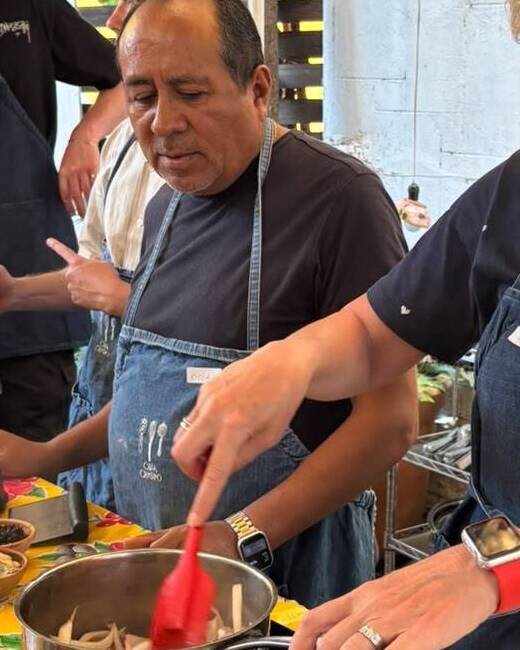
  • Óscar Carrizosa in a denim Casa Crespo apron watches over a pan of onions while a student's hand stirs it with a red spatula.

    Casa Crespo Cooking Classes

    Oaxacan cooking class with market tour / Moles class
    How long
    4 hours
    Taught in
    English
    Price
    1,350 MXN Public class, Tuesday to Sunday from 10:00. Shorter classes on moles, salsas, chocolate and pre-Hispanic cooking
    More about this school
    Format
    Market tour, then cooking in the chef's home

    Oaxaca City cooking school run by chef Oscar Carrizosa focused solely on Oaxacan cuisine, teaching daily market-tour classes covering tortillas, ancestral salsas and mole using produce from his own Mixteca farm.

    Photographs from a student

    Taken by a student

    Alix Verrips learnt here, took these on the day and sent them to me for this page. They are her photographs, not the school's, and credited to her — and they do not move it up the page: where it sits was decided from its own course pages. Any school on this page can have the same space, on the same terms.

    Óscar Carrizosa in a denim Casa Crespo apron watches over a pan of onions while a student's hand stirs it with a red spatula.
    Óscar at the stove with the class.
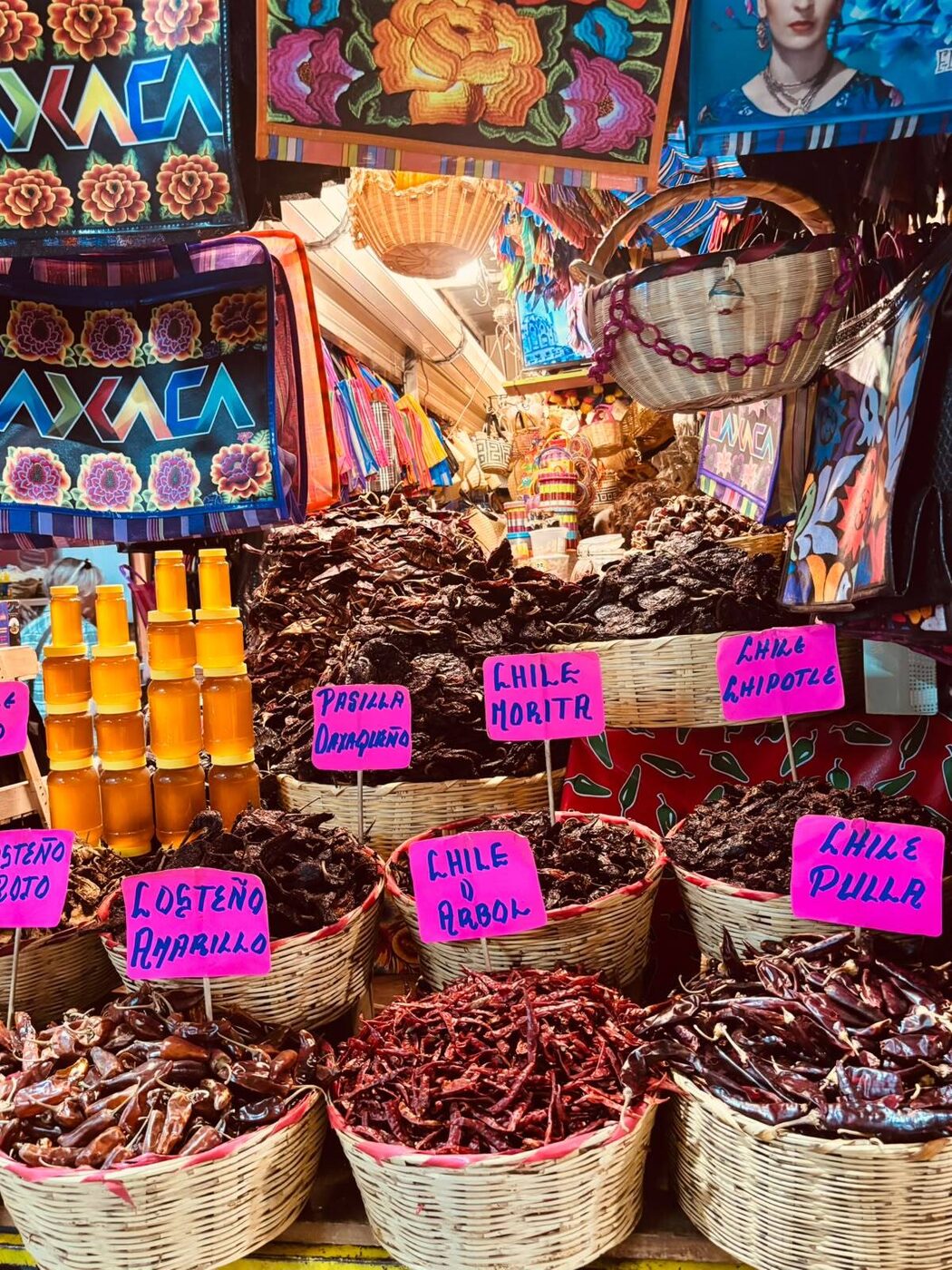
    A market stall in Oaxaca hung with embroidered OAXACA bags above baskets of dried chillies, each labelled on a pink card: costeño amarillo, chile de árbol, pasilla, morita, chipotle, chile pulla.
    The market comes first, with the chef. Each basket of chillies has its name on it.
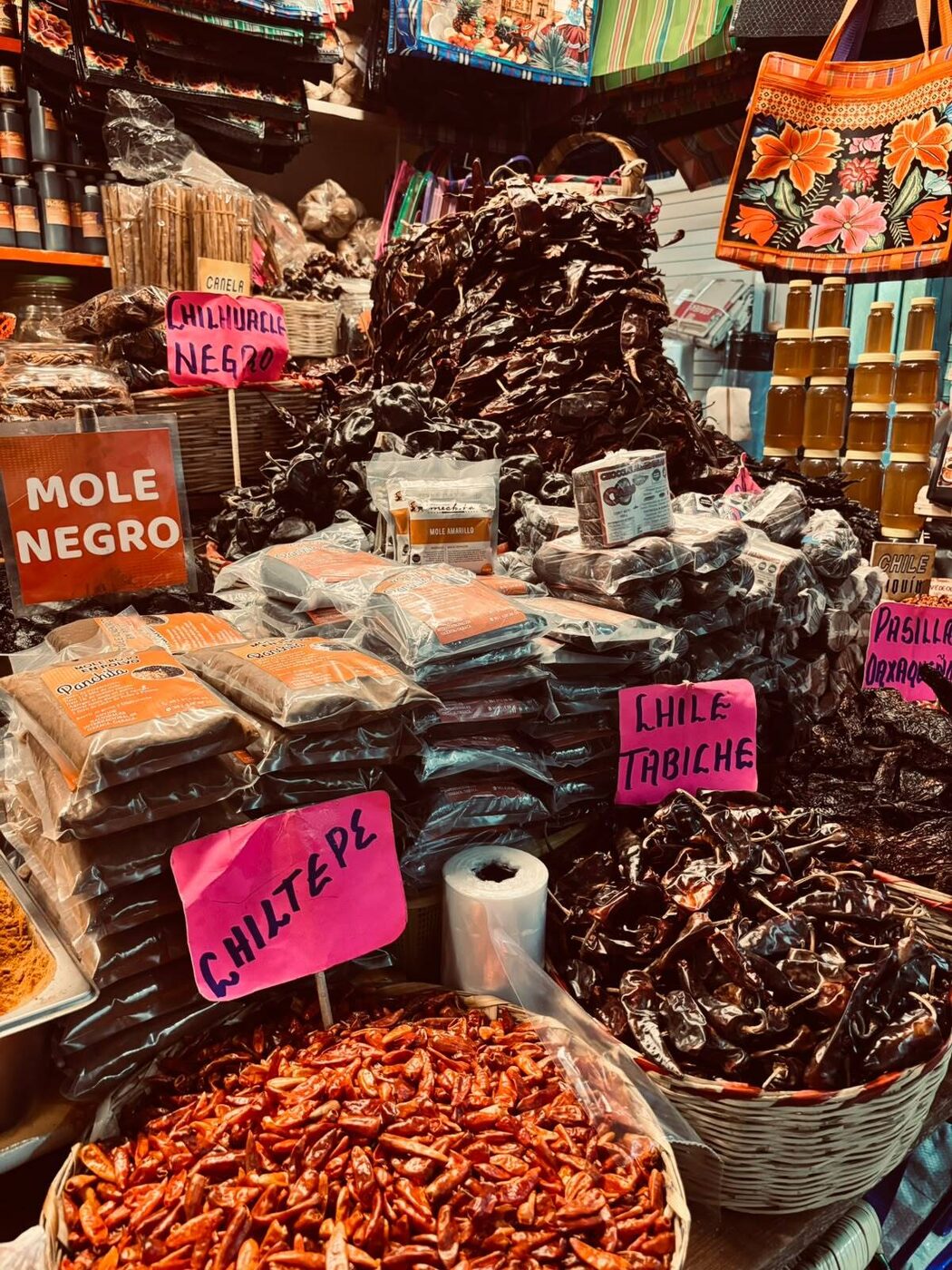
    A market stall stacked with packets of mole paste under a MOLE NEGRO sign, with baskets of chilhuacle, tabiche and chiltepe chillies in front.
    Mole negro at the market, sold as paste, with the chilhuacle and chiltepe chillies beside it.
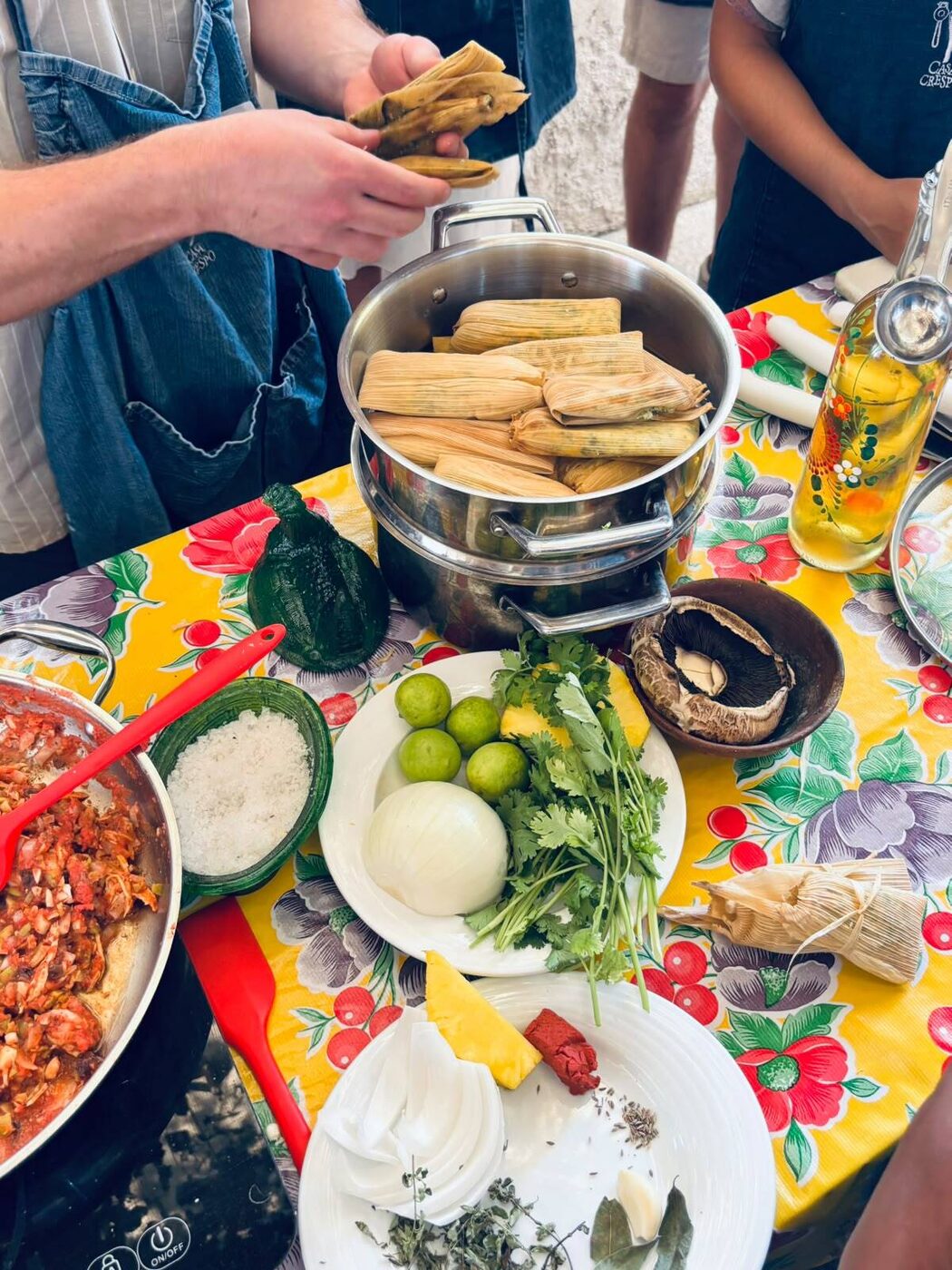
    Hands lifting a tamal in its corn husk from a tall steamer on a flowered oilcloth table, among bowls of lime, onion, coriander, salt and chillies.
    The tamales come out of the steamer, still in the husk.
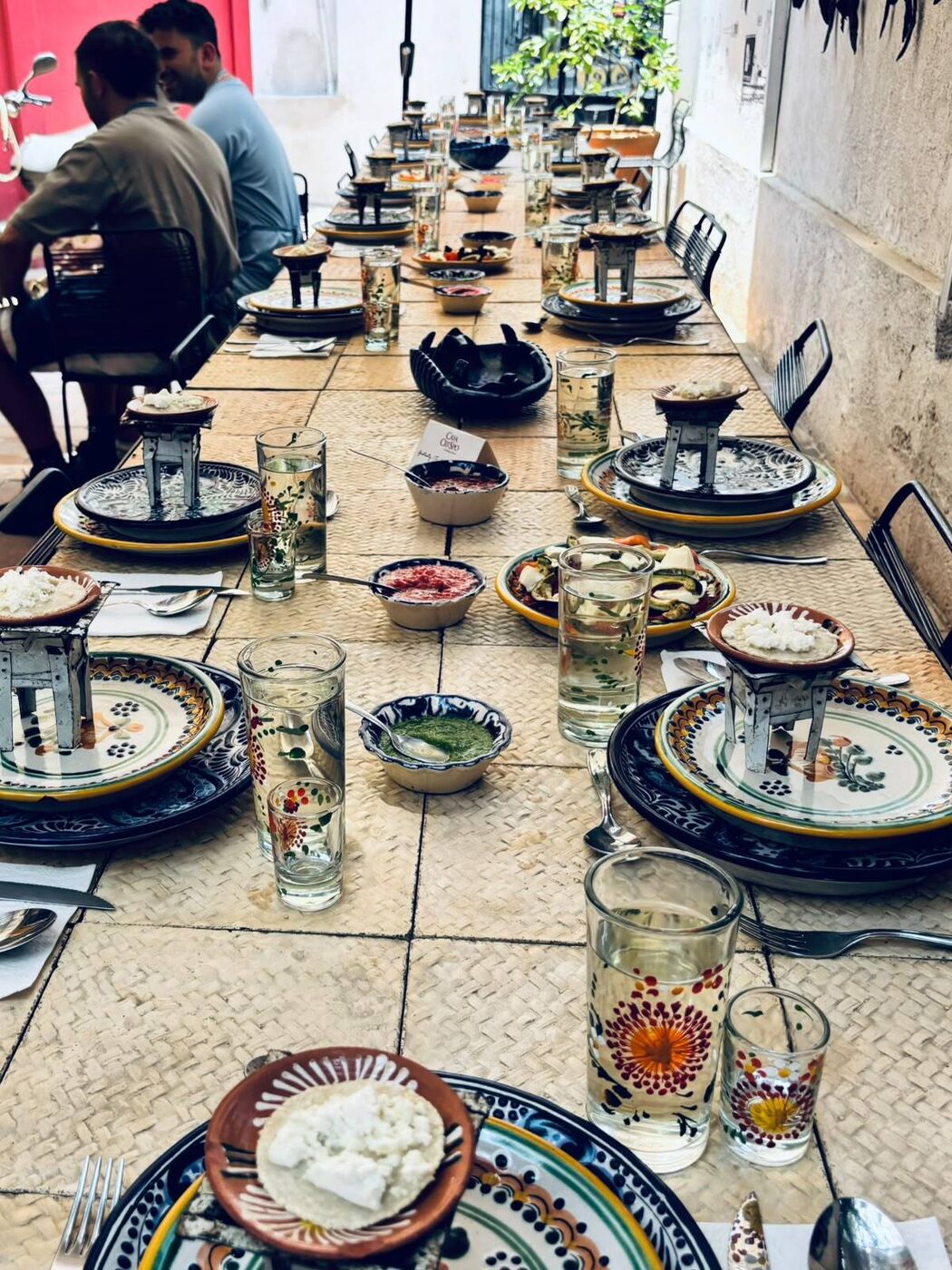
    A long table in the courtyard laid with blue and white Talavera plates, painted glasses and small bowls of salsa, with guests sitting at the far end.
    Then everyone sits at one long table and eats what they made.
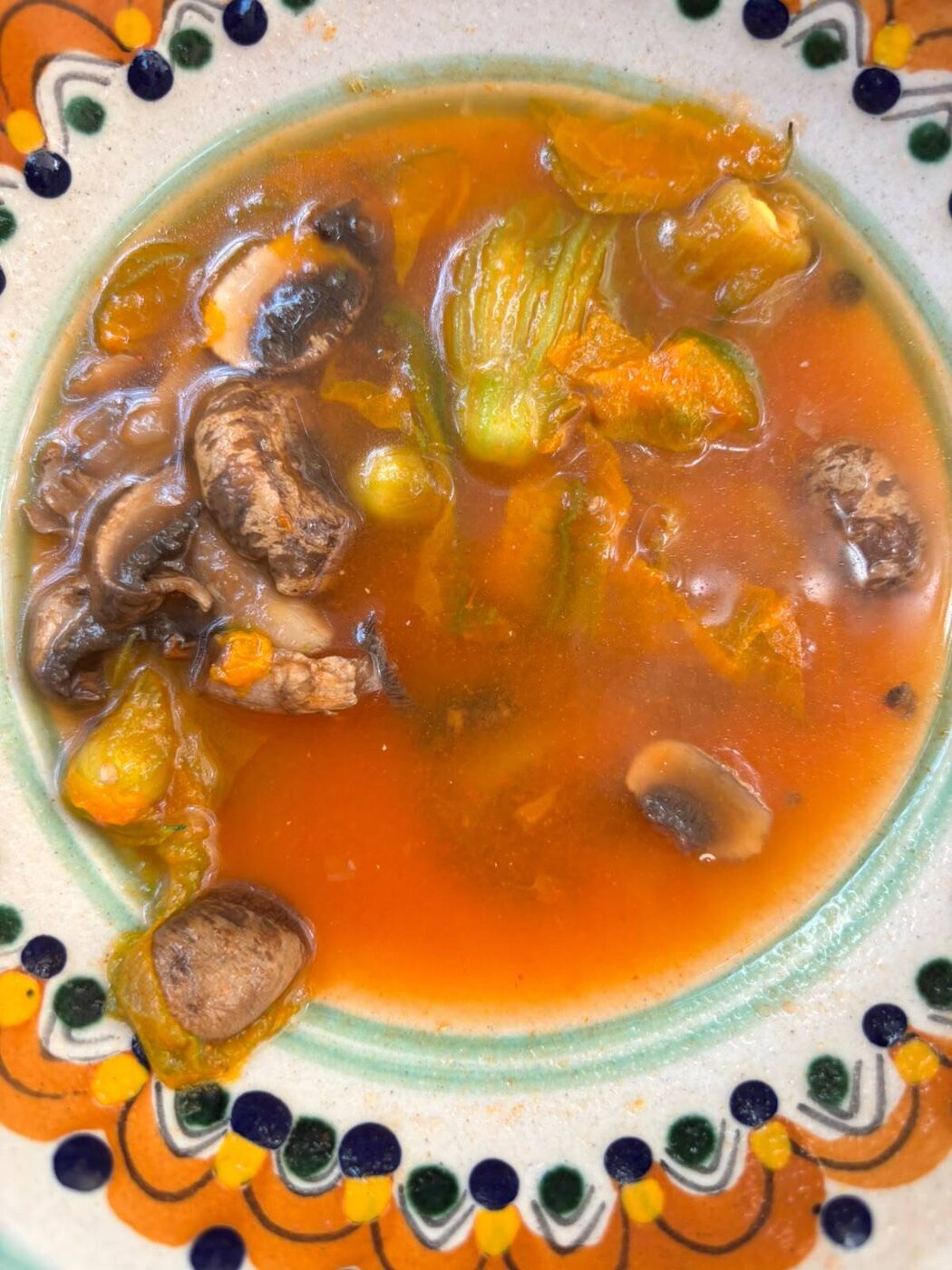
    A bowl of orange broth with mushrooms and squash blossoms on a hand-painted plate.
    A broth of mushrooms and squash blossom, from the day's menu.

    Photographs: Alix Verrips at Casa Crespo Cooking Classes, sent to me 2 Nov 2026. Used with her permission; all rights remain hers.

    Facts read on the school's own pages, 4 Nov 2026.

  • El Sabor Zapoteco (Teotitlan del Valle)

    Traditional Zapotec cooking class
    More about this school

    Cooking class run by Reyna Mendoza in the Zapotec village of Teotitlán del Valle, teaching traditional dishes ground on a metate and toasted on a wood-fired comal in her outdoor kitchen with a village market tour.

  • La Casa de los Sabores (Pilar Cabrera)

    Oaxacan cooking class with market tour
    More about this school

    Oaxaca City cooking school led by chef Pilar Cabrera of restaurant La Olla, teaching hands-on Oaxacan menus including moles for groups of 2-8 with a market tour, mezcal tasting and a five-course meal.

Named in this town

The people this craft is known by here

These names belong to the town. Where we have been able to tie one to a particular school, it is on that school's card above; where we have not, we have not guessed.

What you walk away with

The credential that counts here

Cooking-school immersion certificate (e.g. Seasons of My Heart week-long diploma) · Certifying body: no single body; each school prints its own

That is the one an outside body sets and marks, which is what separates it from a certificate a school prints itself — that proves you attended. We name which of the two a course actually gives you; ask the school the same question before you pay, and judge the answer yourself.

Write me a note about this one — how you'd love to learn it, and where.

If this box never loads, the same note reaches me at arnaudcallier@pm.me.

Same discipline, other sources

Also for Oaxacan & Mexican Cuisine

Why you can trust this map

How a place gets on here, and what we do when it stops being true

There is a real difference between a school that teaches you and a good-looking website, and too much of the internet is the second kind. Four instruments do the work, and every one of them is visible on the page you are already on.

  • We grade it in public, and publish what is missing. The Measure is five plain questions, not a score: is there a teacher we can name, can a stranger get in, will you be learning beside other people, is the craft alive in the place, and is there enough there to keep you going for years. An empty dot tells you which one we could not answer and why. A craft nobody has graded shows no meter at all, because an absence is not a zero.
  • We print what we checked and did NOT list. Every swept craft carries the places we looked at and turned down, each with its reason. That list is the part no marketplace prints, because a rejection is where the money is.
  • The claims are read back to their sources every night. A robot re-reads every link we publish against the school's own page each night, and every price and course name we have written a test for. page. When one stops matching three nights running, it is flagged for a human — and an entry that cannot be confirmed comes off. It is never softened.
  • Where we are not neutral, we say so above the recommendation. We run one paid week a year, with one teacher. His entry says that before it says anything good about him, and prints the way to reach him without us, at his prices.
  • Nothing here has been stood in yet. An open sheet means desk research, carefully done. No place on this map has been visited and dated by us. When one is, the check will carry a name and a date — and until then, the grade says so in the dots it leaves empty.
  • Nobody pays to be here, and nobody can pay to be left off. No commission, no listing fee, no tourist board. The order is the strength of the community, never the size of the wallet.
Before you trust any school — mine or anyone else's — ask these five things
  1. Who actually teaches it? Can you find them by name, with a track record you can check yourself?
  2. Is the craft alive in that place, or is the school the only thing there? A real scene has more than one good option.
  3. What exactly do you walk away with — a recognised qualification, or a certificate they printed themselves? Ask which.
  4. Can you speak to someone who did the course? A real person, not a testimonial on their own page.
  5. What happens on a bad day — weather, an injury, a teacher who doesn't show? A serious place has an honest answer.

If a place dodges these, that's your answer. It costs you nothing to ask, and it tells you everything.

This is the short version. The full method is here — the six questions, in order, for any craft anywhere.